

Bookshelf
Where Is My Flying Car?
A look through a telescope into the future. It’s all about second age atomic energy technology. We are bottlenecked by energy. All major technological revolutions demand greater energy demands, often outpacing supply.
My notes
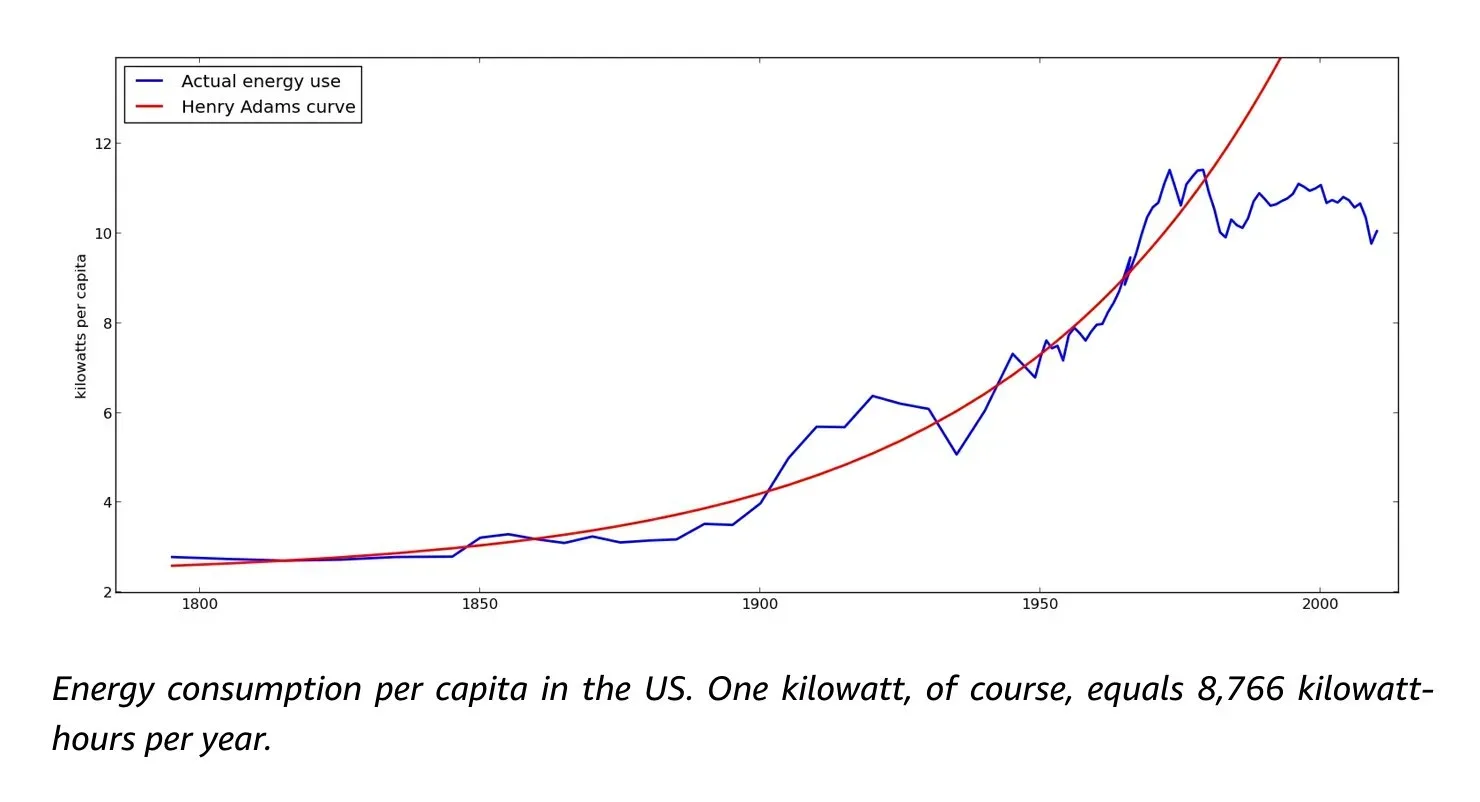
- The Henry Adams curve marks the sudden drop-off in energy production, which coincides with the great American stagnation. Energy production is critical for technological advancements because of Jevons paradox; as technology advances it generally becomes more energy efficient, which increases demand in turn meaning higher energy consumption (think AI data centres and robotics).

-
Cold fusion wasn’t always just pure hype; federal research agendas moved away from this failed experiment
-
The optimal architecture for flying cars must account for the maximal energy expenditure during takeoff and landing i.e., last energy density. VTOLs are the superior form factor.
-
The environmental movement is the modern day equivalent to the Baptist and bootleggers. Climate change has been overdetermined and reducing our energy consumption will have more negative effect then increasing sea level temperatures by 2C. We cannot slow down energy production—only develop more sustainable methods.
-
Fusion theoretically unlocks energy to cheap to metre however we’re very far. DT fusion energy at 100mK unleashes 80% neutrons; which cannot efficiently harness directly into electricity and tritium is a very expensive radioactive prime material.
- D-D fusion uses a non-radioactive abundant prime material found in deep waters and only emits 35% of energy as neutrons at ~400mK. 100mK is already a challenge, 4x that beyond currently superconducting technology (assuming a magnetic confinemnet design).
-
Even fission involves a complicated supply chain. Cf-251 is essential for kick-starting the fission reactor, yet it’s produced only in microgram quantities (MIT).
-
Flying cars will be an ultimate unlock. Cheaper than drilling tunnels and towards a 3D transportation system that can one day support a planet Earth of 100b people, and a galactic species of many hundreds of billions of humans.
-
Chemical rockets are currently the cheapest way to escape Earth’s gravitational field. What about gigastructures that tower of the troposphere with giant elevators? This is possible with abundant materials and atomic energy.
-
Kardashev’s scale is a great way to measure progress relative to the rest of the universe
TYPE POWER ORIGINAL DEFINITION I 17 Sunlight hitting planet II 27 Total power of the Sun III 37 Total power of the galaxy
Rocket Propulsion Elements
Astrophysics for People in a Hurry
The Fabric of Reality
The Beginning of Infinity
“Problems are inevitable, but problems are soluble.”
— David Deutsch
Life 3.0
Superconvergence: How the Genetics, Biotech, and AI Revolutions Will Transform Our Lives, Work, and World
Considerations on the AI Endgame: Ethics, Risks and Computational Frameworks
To Be a Machine
How to Create a Mind
Fundamentals of Deep Learning
Quantum Mechanics and Algorithms
Hacker’s Delight
- Teaches a kind of “bytewise creativity” often lost in high-level abstractions.
Blockchain Revolution
QED
Gödel, Escher, Bach: An Eternal Golden Braid
Understanding complex systems—including our own minds—requires transcending simple rules via analogies and metaphors, and learning how systems can point to themselves.
The Principia
Elements of Chemistry
The Vital Question
The Selfish Gene
Incognito: The Secret Lives of the Brain
Most memorable line:
If our brains were simple enough to be understood, we would not be smart enough to understand them.
My notes
- Optical nerves are unidirectional and there are 10x more nerves going from your brain to yours eyes then the other way around i.e., we see with our brains!
- Our eye has a blind spot which is undetectable unless physically tested. The entire time our brains are filling in the blind spot based on the surrounding pixels.
- Inspired me to write this blog post


- 1/3 of cognition in our brains is dedicated to vision alone
- Decouple the concept of seeing with vision. Even blind humans have vision, since the other 2/3 of the brain (which cannot see) increases in processing power. As an experiment a blind person attached a camera to his head, hooked up to a grid of electrodes on their tongue which signalled objects detected straight ahead from the camera to climb Mount Everest. Blind people also developed excellent hearing, some can use echo location to navigate.
- Neuroplasticity is a measure of the brains ability to attenuate new cognition and it does not decrease with age, but with practice! Always keep your brain working and learning.
The Emotional Brain
Why We Sleep
Thinking, Fast and Slow
Blink
The Book of Why
Elastic
Indra’s Pearls
Sapiens
Bowling Alone
The Future of Capitalism
How Asia Works
The Wealth of Nations: Books I-III
The Wealth of Nations: Books IV-V
The Tycoons
Edison
Elon Musk: Tesla, SpaceX, and the Quest for a Fantastic Future
The Origins of Efficiency
The 4th Turning Is Here
Presidents of War
The Perfect Weapon
Henry J. Kaiser
Shoe Dog
The Lean Startup
The Innovator’s Dilemma
Zero to One
“Brilliant thinking is rare, but courage is in even shorter supply than genius.” — Peter Thiel