
Musings
A stranger once asked me the best way to predict the future to which I replied, “just build it.” That’s why I moved to the greatest country in the world, a country that makes anything possible with the right capital, talent and execution. I came with a plan, but even I have to admit, sometimes we need the wind to be on our side… to get lucky.
My super philosophy
Scale, abstraction and curiosity are the essential primitives for understanding anything.
Abstraction is the framework that allows us to zoom in and out of different scales.
Quarks and leptons, when combined, form the atomic scaffolding of organic matter. Organic molecules, when combined, form the cellular scaffolding for bacteria, plants, animals, and ultimately, conscious systems capable of reflecting on the structure that made them.
Groking large scales down to the primitives requires traversal through long and dense abstraction chains - something only possible with relentless curiosity.
Contrarian takes
We don’t have enough companies. We have not run out of new ideas.
It is commonly said that 99.99% of ideas have already been done. I think the converse is more likely true. 0.01% of ideas have already been done. We have to think bigger.
You should walk straight after a big meal.
Letting your body digest its food will trigger a huge slump. It’s akin to telling yourself you aren’t sick so your body eventually catches up. Nighttime was designed for sleeping not the day.
Don’t specialise early. Generalise early, specialise later.
Coffee keeps you tired and anxious.
You shouldn’t wash your hair with factory chemicals everyday.
Non-doers fail to not give up.
Doers fail to give up.
How problems are easier than what problems
“What are we going to build?” versus “How are we going to build it?”
This might read as a misnomer since it’s difficult to arrive at how without deciding on something to work on - the what.
The ideal problem is one where the how is more difficult to solve than the what. Ruling out the edge cases where both are either trivial or intractable.
How problems are those where the what is easy to understand. For example, cryosleep chambers, anti-matter propulsion engines and nuclear fusion. Their impact on society is non-trivial but how do we do it?
Contrast this with the quintessential what problem: Blockchain. The how has been well understood for years now, distributed consensus, cryptographic verification, programmable ledgers. But what should this actually be used for, where it’s better than conventional systems?
What happened to grandeur?
Where did the large marble columns and painted ceilings go? Where can we seek modern grandeur?
Greco-futurism is an inspiring style. It invokes awe.
Brutalism, despite its melancholic undertone, still invokes permanence. A durable structure that will outlast you, no matter your opinion towards it.
Today’s buildings, don’t look like they’d stand a chance against Godzilla.
Have a bias towards action
When it doubt act. Action produces information. New information is something we can act on, so on and so forth.
A moving man will meet his luck.
Human-computer interfaces
Carefully crafted human-computer interaction is vital to fusing the efficiency of machines with the creativity of humans.
GUIs are one way to do this today and we should strive to make them simple, not simpler.
Tools are not designed to replace us, they’re designed to enhance us.
Robotics is the ultimate form factor. Physical technology built to help humans interact with the real world.
The case for full-stack+
In the context of internet-based product and services, if full-stack refers to frontend + backend, then full-stack+ includes data science and machine learning.
In hardware, it has been widely accepted that to provide the best possible user experience, you have to vertically integrate. It should be no different with pure software products.

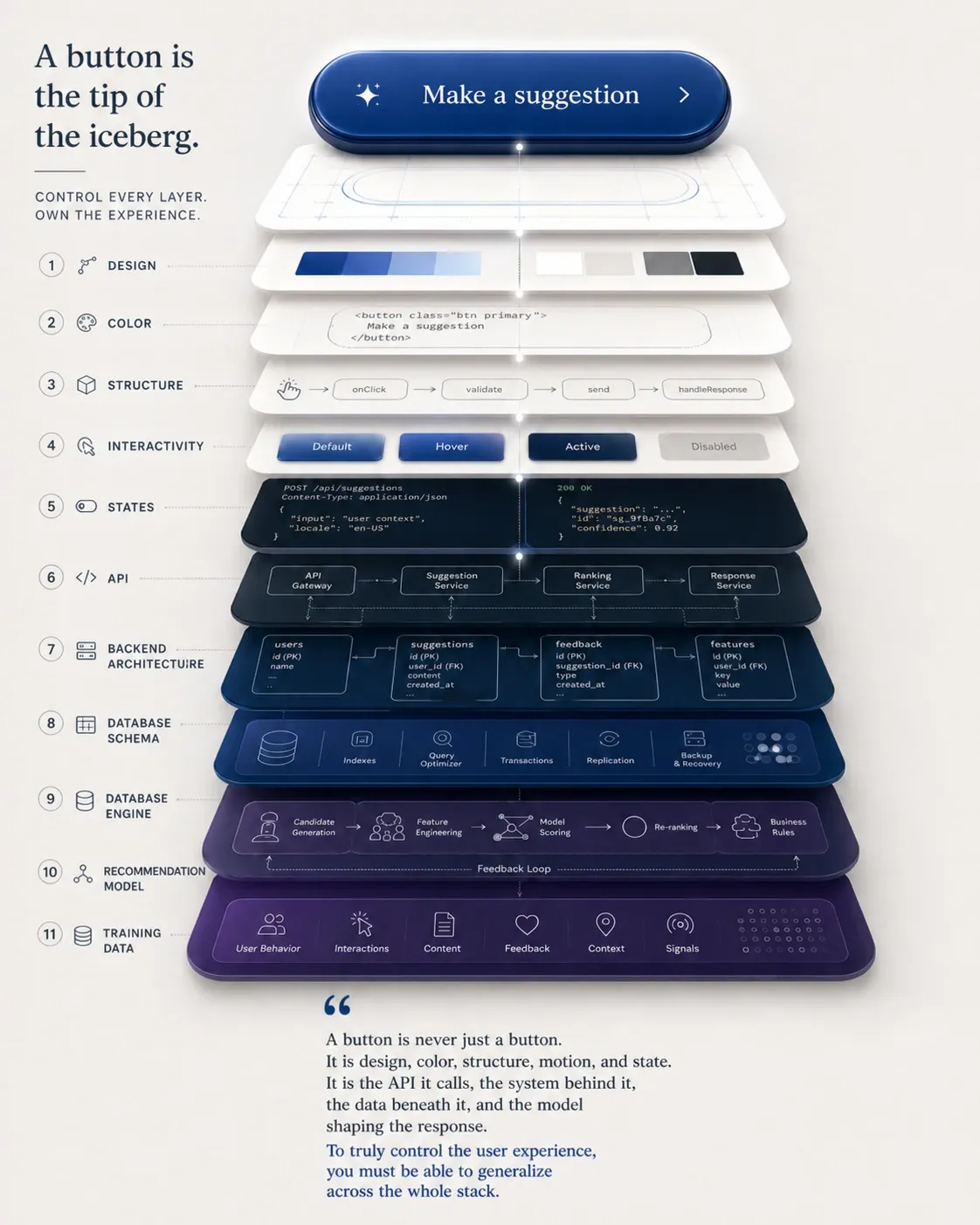
Following this logic, full-stack++ should include physical infra, which you rarely need manage yourself these days.