

Breaking large insurmountable tasks into smaller manageable subtasks enables hyper-productivity. I found that completing a high volume of small tasks results in a larger area under the productivity curve due to a ‘momentum bonus’ when compared to completing fewer monolithic tasks.
Let’s model it mathematically.
Definition. Momentum is mass times velocity, given by . Let’s define velocity to be productivity and mass to be the magnitude of the task being completed.
Consider a one-dimensional collision between two objects and with positive masses and . All velocities are measured along the same axis. Assuming negligible net external impulse during the collision, total momentum is conserved, so
Here and represent the final velocities of and , respectively. This conservation law applies to both elastic and inelastic collisions. The analogy in the context of productivity is switching from task to task after either has been completed or not. The reason I model context switching as a collision is that it lets me compare elastic and inelastic cases. Kind of neat.
For a quick refresher.
- An elastic collision conserves total momentum and total kinetic energy, e.g. an idealised collision between two billiard balls.
- An inelastic collision conserves total momentum under the same assumptions, but some kinetic energy is converted into other forms, such as deformation, thermal energy and sound. If the objects stick together, the collision is perfectly inelastic, e.g. two lumps of putty colliding and sticking.
The coefficient of restitution is designed to quantify collision elasticity. Choose the axis so that approaches with . Then is the relative approach speed and is the relative separation speed, giving
The value of tells us what kind of collision we have.
- is perfectly inelastic; the objects have the same final velocity.
- is partially inelastic; relative separation speed is smaller than relative approach speed.
- is perfectly elastic.
- is superelastic; stored energy is released into translational kinetic energy.
- is the idealised perfect explosion of a rigid system limit.
The entry sits outside the collision model. It describes a limit where the approach speed tends to zero but the separation speed tends to a positive value. At exactly zero initial relative velocity, the ratio is undefined.
Back to productivity.
Case 1. You fully complete task and move onto (elastic).
In an elastic collision, total momentum and total kinetic energy are conserved, although the individual velocities generally change. Momentum conservation gives . For equal masses in a head-on elastic collision, the objects exchange velocities. Godspeed.
Case 2. You don’t fully complete task and move onto (perfectly inelastic).
This case falls under the condition where , which means the objects have the same final velocity, hence . Total kinetic energy decreases, but an individual object can speed up. We can re-arrange to get
Since the masses are positive, the common final velocity lies between the two initial velocities, so
Increasing either initial velocity whilst holding the masses fixed increases the common final velocity. Holding the initial velocities fixed, increasing one mass shifts the final velocity toward that object’s initial velocity. Reducing both masses by the same proportion leaves the final velocity unchanged.
For a simpler case, set and take , giving
Now we can rewrite the equation in terms of the mass ratio and plot , the fraction of incoming velocity retained.
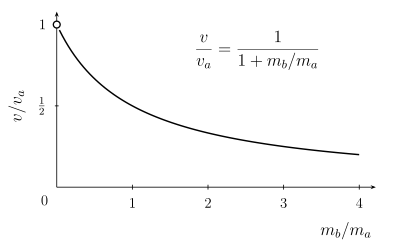
Holding and fixed, reducing increases . The real-world analogy is that keeping productivity on task fixed and moving onto a smaller task , initially at rest, leaves a larger incoming velocity for your next collision, i.e. task .
This is our productivity slider. Want to go faster? Slide to the left. What if you want to tackle bigger tasks? Slide to the right. The trade-offs are quantifiable within the model.
Unfortunately we don’t live in a world where . Reducing only brings closer to in this case. Productivity always feels like it tapers at a physical maximum but there are methods of increasing , and hence .
- Great sleep
- Physical exercise
- Standing desk
- Frequent breaks
- Deep focus/flow state triggered from deep curiosity
After applying some from this list and some from your own list, the next step is decreasing the ratio , whilst keeping both masses positive. Personally, equates to holidays. That’s a joke outside the model. Setting both masses to zero gives , so the final velocity is undefined. I guess it depends how good your holidays were!
We always strive to have our days structured as a sequence of case 1 victories, but reality is much more brutal. I find myself frequently in case 2 territory, but now with a new theoretical framework; a new attack angle.